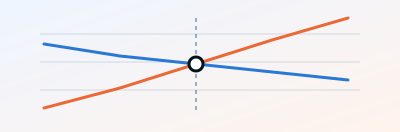
A subscription is a small cost that never stops and usually grows. A custom replacement is a large cost once, then a small one that stays flat. The only question that matters is where those two lines cross — and whether you'll still want this software when they do.
Put your own numbers in. It updates as you type, and it will tell you when the answer is "don't build."
Start from a common tool
Fills in the subscription side with that vendor's published list price for annual billing. Adjust the seat count to match your team.
What you pay now
Time lost to workarounds
What the replacement costs
You break even in month 18 (1.5 years)
A payback inside 18 months is a strong case. Worth getting a fixed-price scope.
The subscription line starts at zero and never stops climbing. The build line starts at the cost of the project and rises only by its running cost. Where they cross is your payback point.
How to fill it in without fooling yourself
Count seats you pay for, not seats you use
The invoice is the truth. If you're paying for eighteen and nine people log in, enter eighteen — and then go and cancel nine seats, which is a better return than any rebuild.
The workaround hours are the field people skip
They're also the field that most often decides the outcome. Three people losing four hours a month at a $45 loaded rate is $540/month — more than many subscriptions, and completely invisible on the invoice. If you don't know the number, don't guess it: track it for a month.
Be pessimistic about the build, realistic about running costs
Use the top of whatever range you've been quoted, and include data migration, which is the line item most often left out. For running costs, 10–20% of the build cost per year is the honest planning figure — that's $100–$200/month on a $12,000 build. Entering $0 there produces a number that is simply wrong. The ownership guide explains where that money goes.
Growth compounds, and it's why the lines cross
A tool at 15 seats growing 15% a year is at 30 seats inside five years. The calculator compounds this monthly, which is why a modest growth rate moves the break-even point so much further left than people expect.
What the answer means
- Under 18 months. A strong case. The main risk left is execution, not economics — get a fixed-price scope.
- 18–36 months. Reasonable, if the process is stable. Ask yourself honestly whether you'll still be working this way in three years.
- Over 36 months. Hard to justify on cost. It only makes sense if the software does something you genuinely cannot buy at any price.
- Never. Keep the subscription. Trim the seats, fix the worst integration, and revisit when headcount or prices have moved.
One caveat this model doesn't capture: risk. A subscription that works is low-risk; a build can go wrong. That's worth a real discount against the projected saving — which is another way of saying a 40-month payback is worse than it looks, and an 8-month payback is better.
Got a number you like? The next question is whether the shape of the problem suits building at all — that's the ten-question checklist.