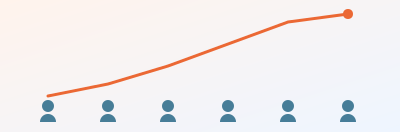
Per-seat pricing is the default business model for business software, and for good reason: it's easy to understand, it scales with the customer, and it feels fair. The problem is what it's actually indexed to. You pay per person who can log in — not per person who gets value, and not per unit of work the software does.
For a growing small business those two numbers separate fast. Here's what that looks like with real published prices.
The same stack at three company sizes
A common small-business stack at 2026 list prices, billed annually. Nothing exotic — this is close to what turns up on most audits.
| Tool | Per seat/mo | 5 people | 15 people | 40 people |
|---|---|---|---|---|
| ● monday.com Pro | $19 | $1,140 | $3,420 | $9,120 |
| ● HubSpot Sales Hub Starter | $15 | $900 | $2,700 | $7,200 |
| ● Google Workspace Business Standard | $14 | $840 | $2,520 | $6,720 |
| ● Airtable Team | $20 | $1,200 | $3,600 | $9,600 |
| ● Field-service platform, per extra user | $29 | $1,740 | $5,220 | $13,920 |
| ○ Accounting + website hosting | flat | $1,788 | $1,788 | $1,788 |
| Total per year | $97/seat | $7,608 | $19,248 | $48,348 |
| Per employee per year | — | $1,522 | $1,283 | $1,209 |
The flat-rate bar does not move across an eight-fold increase in headcount. Every dollar of the growth is per-seat pricing.
Two things stand out. First, the per-employee cost barely improves as you grow — there are no volume economics working in your favour at small scale. Second, five line items out of six grow in lockstep with headcount, so roughly $1,200 of every new hire's first year is software before they have done anything.
The number to know: $1,200–$1,500 per employee per year is where most small businesses land on a mid-tier stack. If you're well above it, something is sitting on a plan you don't need. If you're well below it, you're probably absorbing the difference in manual work.
Where the money actually leaks
Seats that don't log in
The most common finding in an audit, and the easiest to fix without building anything. Nearly every business is paying for people who left, contractors from a finished project, and the "we'll need it eventually" seats bought during onboarding. Ten percent waste is typical; twenty-five percent is not unusual.
Check the last-login column before you do anything else. It's free money.
Minimum seat counts
Several vendors won't sell you fewer than three seats regardless of team size — monday.com's paid plans among them. A two-person business on a $19/seat plan pays for three, which is $228 a year for a login nobody uses.
Read-only people paying full price
The warehouse manager who needs to see the schedule pays the same as the dispatcher who builds it. Some vendors offer free viewer seats — Airtable does — and many deliberately don't, because this is where the margin is. It's worth checking per tool rather than assuming.
Tier jumps for a single feature
This is the expensive one. You need one thing — an API, a custom field, an approval step — and it sits one plan up. HubSpot Sales Hub goes from $15 per seat on Starter to $100 per seat on Professional: not 30% more, nearly seven times more, applied to every seat whether or not that person touches the feature. For an eight-person team that's $1,440 a year becoming $9,600 a year.
The shadow cost: workarounds
Every hour someone spends exporting, re-keying or reconciling data between tools is part of the software bill. Three people losing four hours a month at a $45 loaded rate is $6,480 a year — often larger than the subscription that caused it, and invisible on every invoice.
Where the crossover sits
A custom replacement is a large one-off cost plus a small flat running cost. A subscription is a small recurring cost that grows. They cross somewhere, and where depends almost entirely on your headcount trajectory.
Growth is what moves the crossing point left. At flat headcount the same comparison takes considerably longer to pay back — and at four seats it never does.
| Scenario | 5-yr subscription | 5-yr custom | Difference |
|---|---|---|---|
| 8 seats, flat headcount | $19,200 | $18,000 | $1,200 |
| 15 seats, flat headcount | $36,000 | $18,000 | $18,000 |
| 15 seats, growing 15%/yr | $51,798 | $18,000 | $33,798 |
| 4 seats, flat headcount | $9,600 | $18,000 | -$8,400 |
The last row matters as much as the others. Under roughly six seats on a $40 tool a rebuild loses, and the right answer is to keep paying. Above about twelve seats, or on any tool where headcount is growing, it stops being close.
What to do this week
- Pull last-login data for every per-seat tool and cancel the dead seats. This costs nothing and usually pays for a nice lunch.
- Work out your cost per employee per year and compare it to the $1,200–$1,500 band above.
- Find the tools where the bill grows with hiring but the value doesn't. That's your shortlist, and it's usually one or two line items — not the whole stack.
- Put those through the build-vs-buy checklist and then the calculator.
None of this means per-seat pricing is a scam. For a tool five people use heavily it's often the cheapest possible arrangement. It becomes a trap specifically when your seat count grows faster than the value you get per seat — and that's a measurable thing, not a feeling.
Prices checked September 2026 against each vendor's published list pricing for annual billing: monday.com, HubSpot Sales Hub, Airtable, Google Workspace and Jobber. Vendors change prices often — treat these as the shape of the problem rather than a live quote.